
.svg)




When a physical contaminant is identified in food, traceability is a critical element to minimizing widespread harm and minimizing disrupting the supply chain as little as possible. The more robust a company’s traceability system is, the more likely they are to swiftly identify and remedy the root of the problem. However, traceability has not always been a requirement for food processors, manufacturers, and suppliers —that is, until the Food Safety Modernization Act came into play. Find out how the Food & Drug Administration is taking steps to improve food safety by enacting traceability requirements for domestic and international suppliers.
How The FDA Relates to FSMA
The Food Safety Modernization Act (FSMA) was initially passed by the United States Congress and signed into law by President Barack Obama on January 4, 2011. The purpose of this act is twofold: to expand the FDA’s authority in food safety regulations, and to shift the overall approach of food safety management from a reactive one to a proactive one. As such, FSMA rules that the FDA is responsible for a multitude of key items, including but not limited to establishing regulations and rules, and enforcing compliance. Today, the FDA continues to finalize regulations which dictate how FSMA will be implemented.
Establishing Regulations & Rules
The FDA is responsible for deciding the scope of a given rule along with any parties that the rule may affect. One of these is the Food Traceability Rule (FTR).
The FTR outlines recordkeeping requirements for all domestic and foreign companies who manufacture, process, pack, or hold foods which are present on the Food Traceability List (FTL). The FDA’s Final Rule on Requirements for Additional Traceability Records, published in 2022, added new recordkeeping obligations beyond existing regulations, including:
- Establishing Critical Tracking Events (CTEs)
- Maintaining Key Data Elements, (KDEs)
- Creating and adhering to a Traceability Plan
Enforcing Compliance
While the FDA is responsible for creating proactive food safety rules such as the FTR, it is also responsible for enforcing compliance among food processors, distributors, and retailers across the nation. This includes duties such as establishing compliance dates, issuing facility inspections, requesting records, issuing product recalls, and reprimanding noncompliant businesses with written notices and fines.
Most recently, the FDA has proposed to extend the FTR compliance date. Initially set for January 20, 2026, the proposed extension would allow affected businesses until July 20, 2028 to become fully compliant. This allows businesses to spend more time to plan effectively and work across multiple years of budget to implement a plan that is effective for their due diligence and compliance needs. The comment period for the proposed extension closed in early September 2025, but the extension has not yet been finalized.
Stay Compliant with Product Traceability through Every Stage of Production
Once a proper traceability plan is established, implementation may seem to be easier said than done. For every stage of production across a variety of product applications and industries, there is a possibility for contamination or issues and inconsistencies in food quality. The good news is that for every stage of production, there are technologies capable of detecting and rejecting contaminants, determining that products meet production requirements for count, mass, size, shape or other attributes and storing information on products for product traceability purposes. Advanced food x-ray inspection from Eagle, powered by the latest software, helps ensure food safety and integrity and provides you with traceability that your customers increasingly demand.
Learn more about Eagle’s enhanced x-ray inspection product and how to secure your critical inspection points. Download White Paper >>>
Consumers want to know more about where their food comes from. Retailers and foodservice operators want to be able to answer their consumers’ questions and, for their part, also want more information on sourcing and production. As a manufacturer, you want to ensure the quality and integrity of products from one side of your facility to the other. That’s a lot of interest in food traceability, especially with the initial FTR deadline fast approaching. Thanks to advanced x-ray technology and accompanying software, the need to learn more about products is met with track and trace solutions that identify items through various stages of production. While every manufacturing plant is different, with unique lines and floor plans, food inspection systems from Eagle Product Inspection can be deployed at several key points to support traceability.
Raw Material and Ingredients
To find and reject contaminants as early as possible in the process, Eagle’s x-ray systems scan incoming raw material and, through proprietary SimulTask™ PRO software, capture information on what, when and by whom product was inspected. Because ingredients and raw material can come into a manufacturing plant from different vendors and sources, a thorough early foreign object detection is pivotal in protecting products before the process begins in the facility.
Eagle offers several food inspection systems that find and reject contaminants early in the process for a variety of applications. The RMI 400, for example, is utilized for early detection in poultry and meat. Click here to learn about how x-ray technology offers specific benefits for incoming meat inspection, including greater track-and-trace capability.
On The Line
On the manufacturing or processing line, x-ray systems look for contaminants that may still be present. As items are scanned, the system records whether they have passed validation, and the software that powers Eagle’s x-ray systems can identify the employee who operated the machine at the time of the inspection and x-ray systems can be used for a variety of applications and industries.
Packaged Items
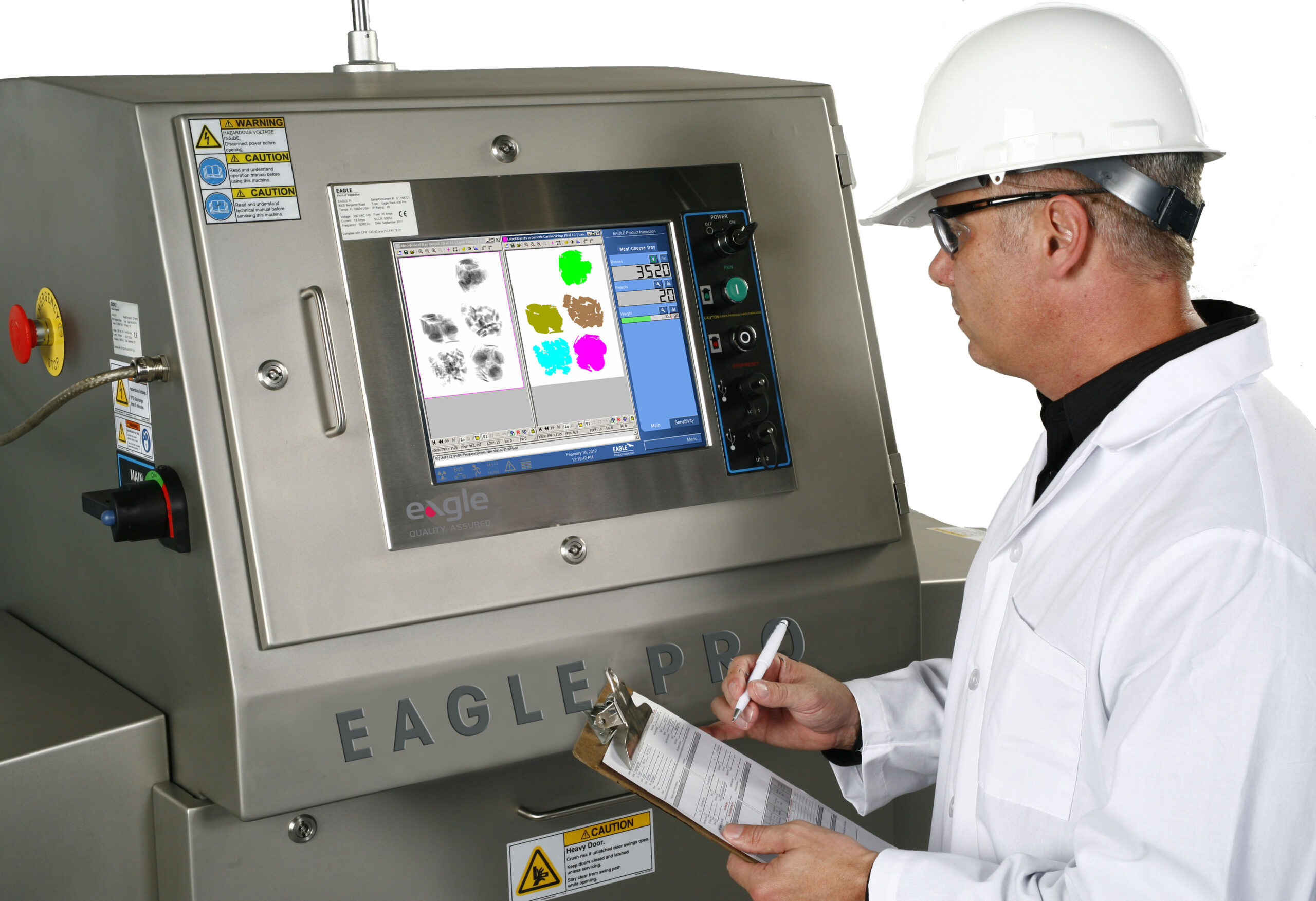
Towards the end of the line, x-ray systems such as the advanced Pack 400 HC or Pack 430 PRO can be utilized to scan packaged or boxed products across a variety of product types and applications to check for contaminants and to help ensure that products are sent out free of contaminants and in the desired form.
Again with Eagle’s proprietary image analysis software, SimulTask™ PRO, manufacturers can get onscreen diagnostics for better quality assurance and traceability making it easier to locate contaminated product and potential entry points in the production stream. With TraceServer™ enhanced data collection, images and information can be captured, stored, shared and easily retrieved for auditing.
FDA & FSMA FAQ
Q: What are Critical Tracking Events (CTEs) & Key Data Elements (KDEs)?
A: CTEs are defined production or movement steps (e.g. harvest, processing, distribution) and KDEs are specific data points (lot, dates, quantities) that must be recorded for those events.
Q: When must companies provide traceability data to FDA?
A: Covered entities must furnish traceability records (KDEs/CTEs) to the FDA within 24 hours, or within a shorter period if FDA requires.
Q: What happens if a company fails to meet FDA traceability requirements?
A: Noncompliance can lead to FDA enforcement actions including warning letters, product holds, recalls, or other regulatory penalties.
Talk to An X-ray Expert
If you have questions regarding x-ray and benefits to your line, fill out this form to talk to an expert.
"*" indicates required fields


